
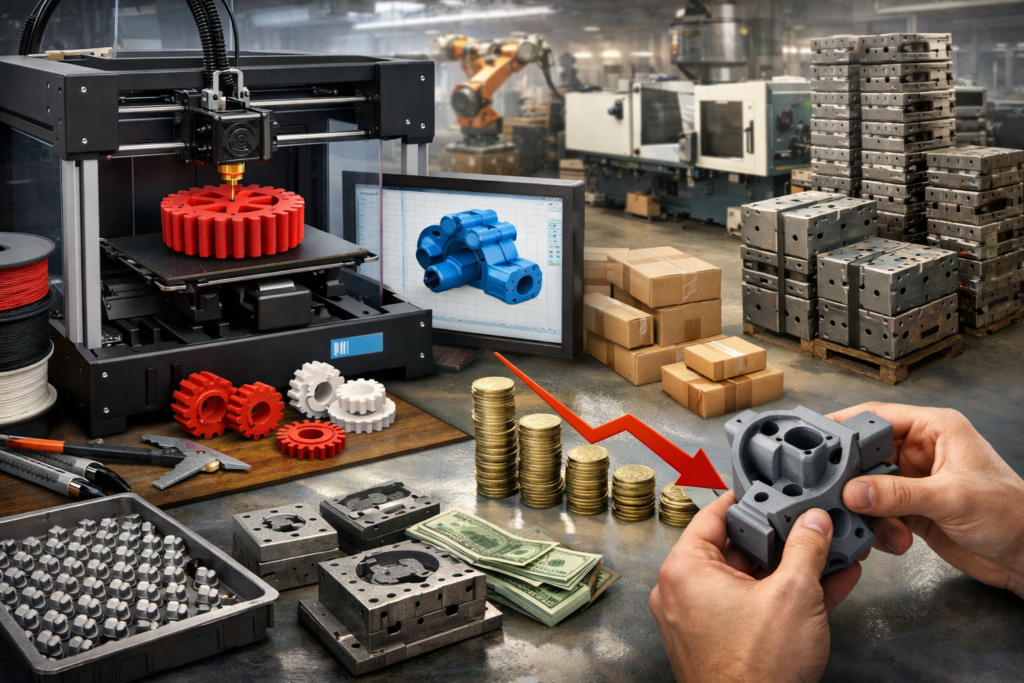
Manufacturing cost is a major concern for industries, startups, and product designers. Traditional manufacturing methods often require expensive molds, machining, and long production cycles. 3D printing, also known as additive manufacturing, offers a cost-effective alternative that helps companies save money while maintaining quality.
Eliminates Expensive Tooling
Traditional manufacturing requires molds, dies, and fixtures, which can be very expensive to create. With 3D printing, parts are printed directly from a digital file, eliminating the need for tooling.
This significantly reduces upfront investment, especially for prototypes and low-volume production.
Reduces Material Waste
In traditional machining, a large amount of material is cut away and wasted. 3D printing builds parts layer by layer, using only the material required to create the part.
This efficient use of material lowers raw material costs and supports eco-friendly manufacturing.
Faster Production
Time is money in manufacturing. 3D printing allows companies to produce parts in hours or days instead of weeks. Faster production reduces labor costs and speeds up product development.
Easy Design Changes
Making design changes in traditional manufacturing can be expensive. With 3D printing, you can modify the digital model and print a new part without extra tooling or setup costs.
Lower Inventory Cost
Companies can print parts on demand instead of storing large inventories. This reduces storage costs and minimizes the risk of obsolete parts.
Conclusion
3D printing reduces manufacturing cost by eliminating tooling, reducing material waste, speeding up production, and allowing flexible design changes. It is a smart choice for companies looking to improve efficiency and stay competitive.
Whether for prototypes or small-batch production, 3D printing offers a cost-effective manufacturing solution.